
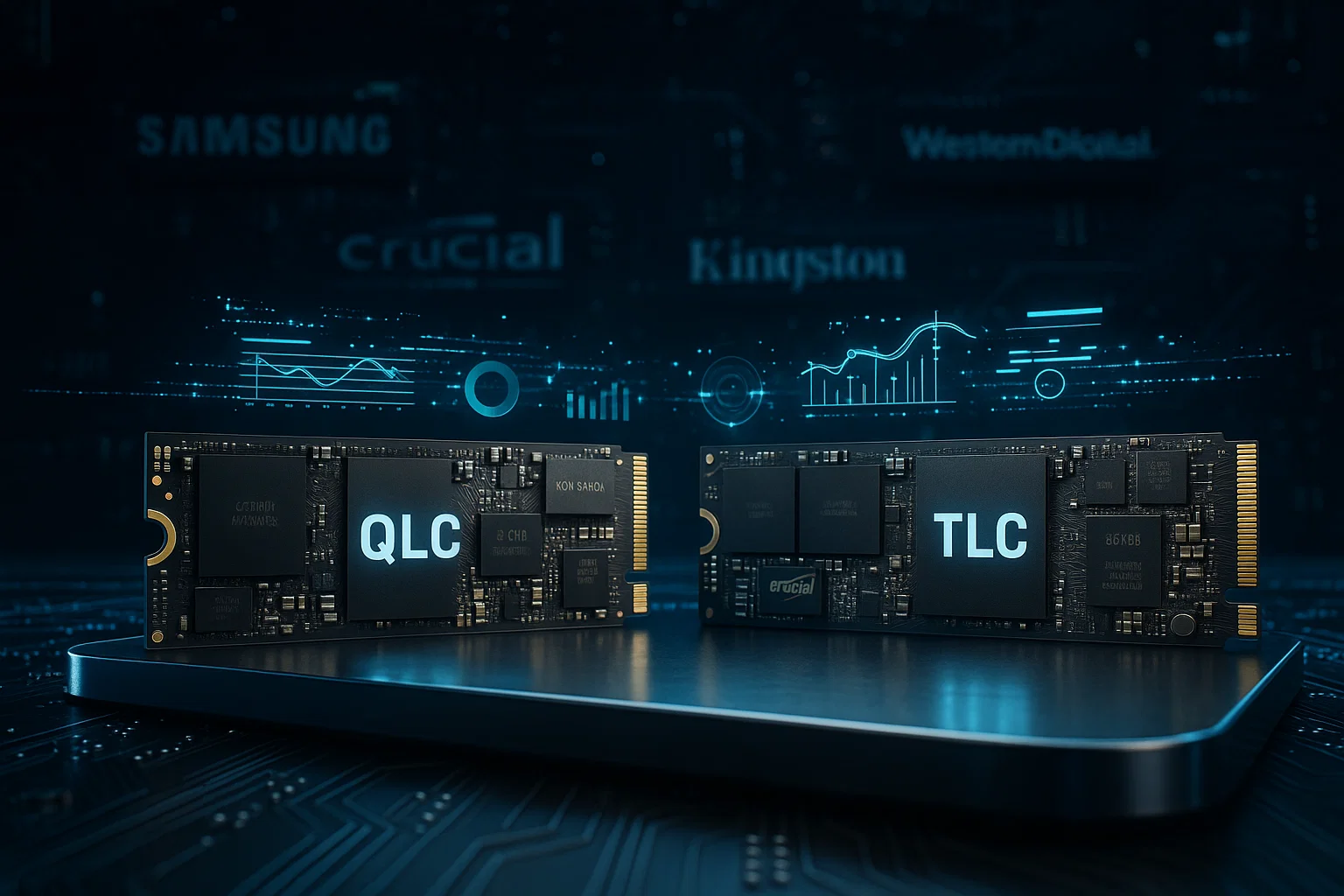
In today’s rapidly growing storage market, the shift from traditional hard drives to solid state drives is stronger than ever. Companies, IT departments, distributors, and system integrators now prefer SSDs because of their speed, reliability, and efficiency. Yet with so many SSD types available, choosing the right one for large-scale deployment requires more than just checking capacity and price. One of the most important decisions comes down to understanding QLC and TLC technology. For Bulk Buyers planning to scale storage across hundreds or thousands of systems, knowing the difference between these two NAND types can save money, reduce failure rates, and improve long-term performance. This guide breaks the topic down clearly and helps you choose the right SSD for your next procurement cycle.
Why Bulk Buyers Need to Understand NAND Types
When purchasing drives individually, most users never look beyond capacity and brand. But Bulk Buyers operate differently. When hundreds of SSDs power workstations, security systems, servers, kiosks, POS terminals, or industrial hardware, even small performance differences can compound over time. Additionally, reliability and endurance matter much more at scale. Understanding what each NAND technology offers ensures better forecasting, smarter budgeting, and fewer support issues down the line. By grasping the strengths and weaknesses of QLC and TLC, Bulk Buyers can match SSD types to workload needs instead of relying on assumptions.
QLC vs TLC A Simple Breakdown for Bulk Buyers
What Is TLC NAND and Why Does It Matter
Triple Level Cell NAND, commonly known as TLC, stores three bits of data per cell. This structure strikes a balance between performance, reliability, and cost. Brands like Samsung, Kingston, Western Digital, Crucial and Lexar often use TLC in their mainstream and professional SSD lineups because it provides consistent speed for both read and write operations.
TLC SSDs have higher endurance ratings compared to QLC models. They can handle a larger number of write cycles before showing signs of wear. This is why TLC remains the preferred choice for business environments, cloud servers, gaming systems, and heavy-use machines. Moreover, TLC SSDs maintain stable speeds even after the SLC cache fills, which is a common bottleneck in lower-tier drives.
What Is QLC NAND and Who Is It Designed For
Quad Level Cell NAND, known as QLC, stores four bits of data per cell. Because each cell holds more information, manufacturers can offer higher capacities at a lower cost. Well-known brands including Intel, Micron and Solidigm have pushed QLC technology into the mainstream, especially for budget-friendly high-capacity SSDs.
However, storing more bits per cell also creates some limitations. QLC drives typically have slower sustained write speeds, reduced endurance, and a higher chance of performance drops once the cache is exhausted. Even so, QLC shines in read-heavy workloads such as media libraries, document storage, OS-imaging, analytics terminals, and consumer devices where write operations are minimal.
This makes QLC especially attractive for Bulk Buyers working with large data archives, low-intensity computing environments, and deployments where capacity per dollar matters more than long-term write endurance.
Performance Comparison QLC vs TLC for Different Use Cases
Speed and Daily Performance
TLC SSDs consistently outperform QLC SSDs in both read and write operations. Brands like Samsung 870 EVO, Kingston KC600 and Crucial MX500 demonstrate how TLC technology maintains fast speeds even during heavy multitasking. QLC models, including the Crucial P3 and Solidigm P41 Plus, offer solid read performance but drop noticeably during large file writes or continuous workloads.
For Bulk Buyers supporting high-traffic apps, frequent software updates, virtualization, or content creation, TLC delivers smoother performance and fewer slowdowns.
Endurance and Lifespan
Endurance is one of the most critical factors for Bulk Buyers. TLC SSDs generally offer two to three times the endurance of QLC models. Since QLC stores more bits per cell, it wears out faster during continuous writes. For large corporate environments with daily logs, backups, heavy IO activity or data processing tasks, TLC is the more stable long-term option.
However, if the workload is read-focused and minimal on repeated writes, QLC still provides excellent value.
Capacity and Pricing
QLC SSDs dominate in price-to-capacity value. For large deployments where maximizing storage at a low cost is a priority, QLC offers impressive affordability. Brands commonly price QLC drives significantly lower than equal-capacity TLC drives, making them perfect for low-write systems like shared terminals, educational systems, IPTV boxes, and surveillance playback stations.
TLC SSDs, although slightly more expensive, offer better all-around performance. For Bulk Buyers who want stability, durability and the best balance of speed and endurance, TLC remains the safer investment.
READ ALSO: Software Dowsstrike2045 Python
Real-World Business Scenarios
To illustrate which SSD type fits which use case, here are a few typical deployments:
TLC Works Best For
Enterprise laptops and desktops
Servers and virtualization nodes
Database applications
Security systems with constant writes
POS systems with high transaction activity
AI or analytics workloads
Backup or caching servers
QLC Works Best For
Media libraries and content distribution
Document archives and cloud storage nodes
General office systems with light workloads
Education labs and low-usage terminals
Client imaging and OS deployment
High-capacity offline storage
By aligning your workload with the right NAND type, you ensure your investment remains efficient and scalable over time.
How Bulk Buyers Should Evaluate SSDs Before Ordering in Large Quantities
Consider Workload Intensity
Before you buy SSDs in bulk, it is important to define how demanding the workload will be. If the systems will be used for resource-intensive tasks or constant data processing, TLC is the clear winner. But if the installation requires large storage with minimal daily write activity, QLC offers exceptional savings.
Compare Brands and Controller Technology
Not all SSDs perform the same even within the same NAND category. A QLC drive from Solidigm may outperform a low-tier TLC drive from another brand due to controller quality and firmware optimization. Brands like Samsung, Crucial, Kingston and Western Digital consistently deliver reliable products in both categories.
Evaluate Endurance Ratings
Bulk Buyers should always check TBW or Drive Writes Per Day values. Doing so allows you to project long-term reliability based on your workload. TLC will almost always provide better endurance, but high-quality QLC drives can still perform well when used correctly.
Test a Small Batch Before Scaling
Even the best SSD specifications cannot replace real-world testing. Bulk Buyers should always start with a small pilot batch to ensure compatibility with their hardware, software, and performance requirements. Once confirmed, scaling becomes safer and more predictable.
The Future of QLC and TLC Technology for Bulk Buyers
Although TLC remains the standard for high-performance and enterprise workloads, QLC technology is rapidly improving. Major brands continue to enhance controllers, caching methods, and error correction algorithms. Over the next few years, we will likely see QLC used more widely in business environments as its performance stabilizes and endurance ratings increase.
At the same time, TLC is not going anywhere. It will remain the reliable backbone for professional and commercial systems where speed, durability, and consistency matter.
For Bulk Buyers, understanding these trends helps in long-term planning. Choosing the right SSD type today ensures a smoother transition as storage technology evolves.
Conclusion
QLC and TLC SSDs both have their place in modern storage planning. The key is understanding the needs of your environment and selecting technology that matches those demands. TLC excels in speed, endurance, and overall reliability, making it ideal for high-intensity workloads. QLC provides unbeatable capacity and affordability for read-heavy or light-use deployments.
Bulk Buyers who understand the difference can optimize budget, performance, and long-term system health. By analyzing workload, comparing trusted brands, and testing before scaling, you ensure that every SSD investment delivers the maximum return.
 Muhammad Usama