


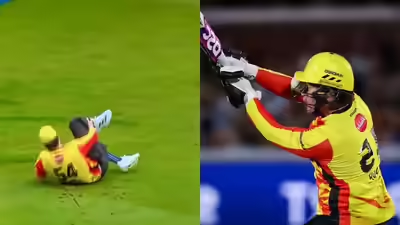
Introduction: The Unsung Hero of Cricket Mechanics
When we think of cricket, images of powerful drives, lightning-fast deliveries, and spectacular catches come to mind. Rarely does the spotlight fall on the complex biomechanics that make these moments possible, particularly the critical role of the ankle joint. This often-overlooked hinge is, in fact, a cornerstone of cricket performance, influencing everything from a bowler’s delivery stride to a batter’s footwork and a fielder’s agility. Understanding the ankle’s function in cricket isn’t just academic; it’s essential for enhancing performance, preventing career-threatening injuries, and extending a player’s time at the crease or on the bowling mark.
- Introduction: The Unsung Hero of Cricket Mechanics
- The Pivot Point: How Your Ankle Dictates Every Move in Cricket
- The Batter’s Foundation: Footwork and Force Generation
- The Bowler’s Spring: Launch, Landing, and Leverage
- The Fielder’s Agile Ally: Reacting and Throwing
- The Weak Link: Common Ankle Injuries in Cricket and How They Happen
- Building a Fortress: Strengthening and Protecting the Cricket Ankle
- From Twinge to Recovery: Navigating an Ankle Injury
- Conclusion: An Investment in Your Cricket Longevity
The Pivot Point: How Your Ankle Dictates Every Move in Cricket
The ankle is a marvel of biological engineering—a sophisticated joint that must provide both rock-solid stability for forceful movements and fluid mobility for quick directional changes. In cricket, these dual demands are tested to their limits.
The Batter’s Foundation: Footwork and Force Generation
For the batter, the ankles are the first point of contact with the ground, setting the stage for every shot. The front foot ankle must stabilize to create a firm base for shot execution, especially when driving off the front foot. It absorbs the forward momentum and locks to transfer energy from the ground up through the kinetic chain—legs, core, torso, arms, and finally into the bat. Conversely, the back foot ankle often requires greater mobility, allowing for rotation in hooks and pulls. The subtle “press” or initial movement a batter makes is almost entirely governed by ankle flexion, enabling the quick shifts in weight needed to get into position for spin or pace.
The Bowler’s Spring: Launch, Landing, and Leverage
A bowler’s ankle is subjected to immense stress, acting as both a coiled spring and a shock absorber. In the delivery stride, the back ankle plantarflexes (points the toe) to push off the crease, generating crucial horizontal speed. The front ankle then faces the ultimate test at the moment of back-foot contact and front-foot landing. It must be stable enough to withstand forces up to 8-10 times body weight, yet mobile enough to allow the bowler’s body to rotate and align for release. For fast bowlers, the repetitive, high-impact landing is the primary site for stress fractures and chronic ankle pain, making ankle strength non-negotiable.
The Fielder’s Agile Ally: Reacting and Throwing
Fielding demands explosive lateral movements, sudden stops, and powerful throws from awkward positions. The lateral agility needed for a slip fielder to react to an edge, or for a cover fielder to cut off a boundary, originates from strong, responsive ankles. The ability to “push off” laterally in either direction is key. Furthermore, when throwing from the deep, the ankle is integral to the crow-hop technique, where the final planting of the foot and transfer of weight through a stable ankle adds significant power and accuracy to the throw.
The Weak Link: Common Ankle Injuries in Cricket and How They Happen
Despite its strength, the ankle is vulnerable. Cricket’s unique movements create specific injury risks that every player, coach, and physio must recognize.
1. Sprains and Ligament Damage: The most frequent offender. A batter quickly changing direction while running between wickets can easily roll an ankle on an uneven outfield. A fielder landing from a leap or stepping on a ball hidden in the grass is also a prime candidate for a lateral ankle sprain, stretching or tearing the anterior talofibular ligament.
2. Stress Fractures: The bowler’s bane. Repetitive micro-trauma from the front foot slamming down delivery after delivery can cause hairline fractures in the bones of the ankle, particularly the talus or distal tibia. These are insidious, starting as a nagging pain that worsens with activity and can sideline a player for months if not managed early.
3. Tendinopathies: Overuse leads to inflamed tendons. Achilles tendinitis is common in bowlers and older players, resulting from the constant push-off and calf strain. Posterior tibial tendinitis can also occur, affecting the stability of the foot’s arch during long bowling spells or batting sessions.
4. Chronic Instability: A consequence of poorly rehabilitated initial sprains. The ligaments remain lax, causing the ankle to “give way” frequently during routine cricket activities, severely hampering performance and confidence.
Building a Fortress: Strengthening and Protecting the Cricket Ankle
Prevention is always better than rehabilitation. A proactive ankle care regimen is as vital as net practice.
Strength and Stability Exercises
- Calf Raises (Bilateral & Unilateral): The cornerstone. Builds the gastrocnemius and soleus, the primary muscles supporting the ankle.
- Resistance Band Work: Alphabet drills (drawing letters with your toe) and resistance band inversions/eversions build the often-neglected stabilizer muscles around the ankle.
- Balance Training: Single-leg stands progressing to single-leg stands on an unstable surface (like a folded towel or balance pad). This trains the proprioceptive nerves—the body’s internal GPS that tells the brain where the joint is in space, crucial for preventing missteps.
- Plyometrics: Hopping and bounding exercises, starting on two legs and progressing to single-leg hops, train the ankle to absorb and react to explosive forces safely.
The Gear Factor: Boots and Taping
Choosing the right cricket footwear is critical. Spiked shoes must offer excellent lateral support without restricting necessary flexion. For players with a history of ankle issues, high-top boots can provide additional external stability. Zinc oxide tape or kinesiology tape applied in a “figure-eight” or “stirrup” method can offer supplemental support during matches or heavy training sessions, but should not replace inherent strength.
From Twinge to Recovery: Navigating an Ankle Injury
If injury strikes, a structured recovery pathway is essential.
- Immediate Action: Follow the POLICE principle (Protect, Optimal Load, Ice, Compression, Elevation). Avoid harmful movement but begin gentle, pain-free mobility as soon as possible to promote healing.
- Professional Diagnosis: See a sports physician or physiotherapist. An X-ray or MRI may be needed to rule out fractures and assess ligament damage.
- Staged Rehabilitation:
- Phase 1: Reduce pain and swelling, restore range of motion.
- Phase 2: Restore strength, balance, and proprioception.
- Phase 3: Cricket-specific functional training—simulating bowling actions, batting footwork, and fielding movements.
- Phase 4: Graduated return to play, ensuring the ankle is ready for the rigors of match intensity.
Conclusion: An Investment in Your Cricket Longevity
The ankle in cricket is far more than a simple connector between leg and foot. It is the dynamic platform for power, the agile pivot for precision, and a vulnerable joint requiring diligent care. By moving it from an afterthought to a focal point of training—through targeted strengthening, intelligent gear choices, and respectful recovery—players at all levels can unlock more consistent performance and build resilience against one of the sport’s most common setbacks. In the grand contest of cricket, where matches are won by inches and hundredths of a second, strong, stable, and smart ankles are not just an advantage; they are a necessity.
