

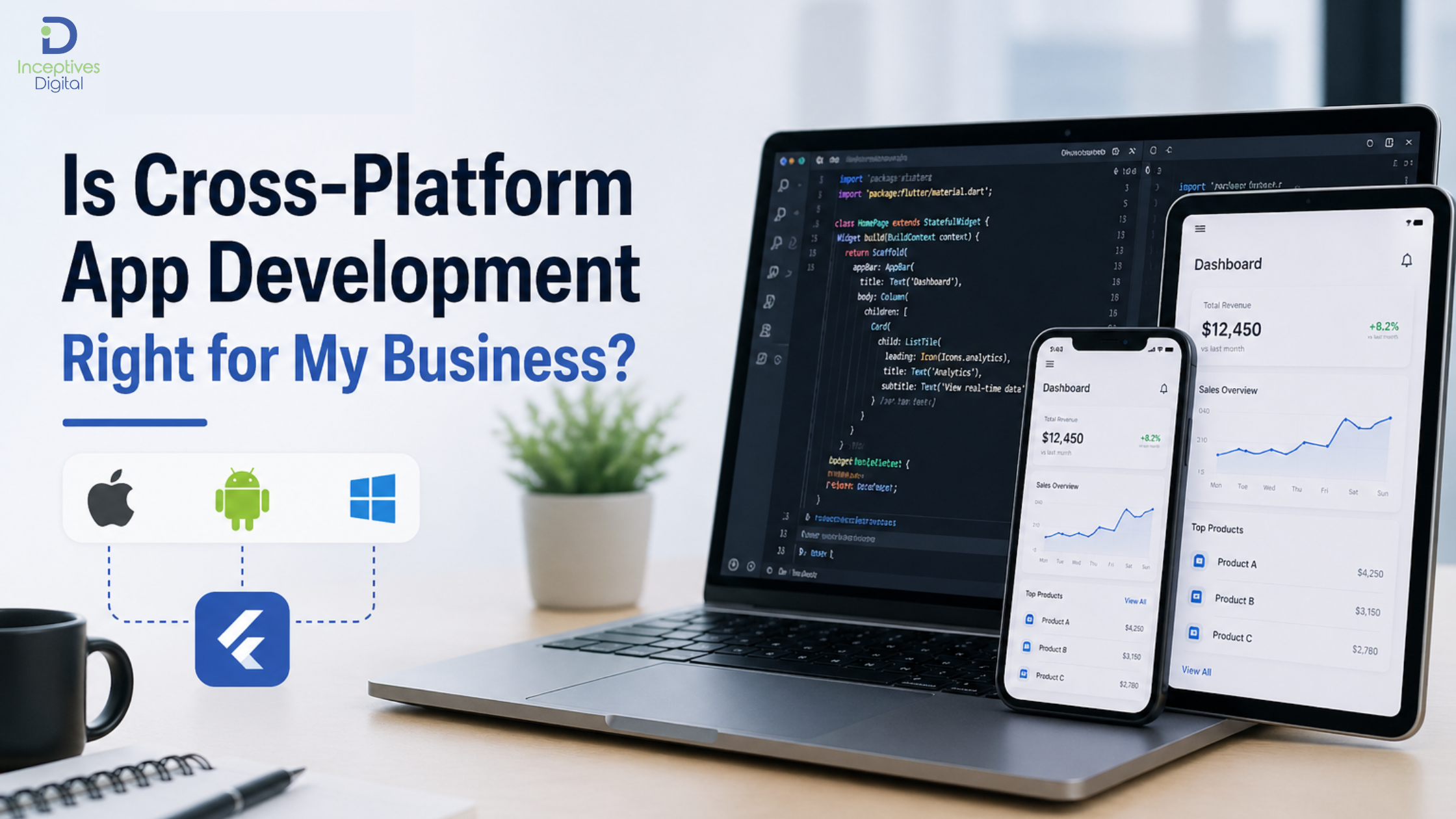
Businesses today are under constant pressure to launch apps faster, reduce development costs, and reach users across multiple devices. That’s one reason cross-platform development has become one of the most discussed approaches in the mobile industry.
- What Is Cross-Platform App Development?
- How Cross-Platform Development Works
- Why Businesses Are Choosing Cross-Platform Apps
- When Cross-Platform Development Makes Sense
- 1. Startups and MVPs
- 2. Content-Based Apps
- 3. Budget-Conscious Businesses
- 4. Businesses Prioritizing Speed
- When Cross-Platform Development May NOT Be Ideal
- 1. High-Performance Gaming Apps
- 2. Apps Requiring Deep Hardware Integration
- 3. Highly Complex Enterprise Systems
- Native vs Cross-Platform Development
- Best Cross-Platform Frameworks
- Performance: Are Cross-Platform Apps Good Enough?
- Real-World Companies Using Cross-Platform Frameworks
- Cost Savings of Cross-Platform Development
- Common Challenges in Cross-Platform Development
- 1. Platform-Specific UI Differences
- 2. Third-Party Dependency Risks
- 3. Delayed Access to Native Features
- Questions Businesses Should Ask Before Choosing Cross-Platform Development
- Future of Cross-Platform App Development
- Is Cross-Platform Development Right for Small Businesses?
- Is Cross-Platform Development Right for Enterprises?
- Final Thoughts
Instead of building separate apps for Android and iOS, companies can now use a shared codebase to develop applications for both platforms simultaneously. For many brands, this approach saves time and money while simplifying long-term maintenance.
As a result, many startups and enterprises now work with a cross-platform app development company to accelerate product launches and improve scalability.
But is cross-platform development actually the right choice for your business?
The answer depends on your goals, budget, audience, and app requirements. In this guide, we’ll explore how cross-platform development works, its advantages and disadvantages, and how to determine whether it fits your business strategy.
What Is Cross-Platform App Development?
Cross-platform app development is the process of building a single mobile application that works on multiple operating systems, primarily Android and iOS.
Instead of writing separate codebases for each platform, developers use frameworks that allow shared code to run across devices.
Popular tools like Flutter and React Native have made this approach more efficient and widely adopted.
How Cross-Platform Development Works
Traditional native development requires:
- Swift or Objective-C for iOS
- Kotlin or Java for Android
Cross-platform frameworks simplify this by allowing developers to write most of the app logic once.
The framework then translates or renders the app for multiple operating systems.
This means:
- faster development
- easier updates
- lower maintenance effort
Why Businesses Are Choosing Cross-Platform Apps
The demand for faster digital transformation has pushed businesses toward more efficient development methods.
Here are some major reasons companies choose cross-platform development.
1. Faster Time to Market
Launching quickly can be a competitive advantage.
With shared codebases, development teams avoid duplicating work across platforms.
This significantly reduces:
- coding time
- testing cycles
- deployment timelines
For startups, especially, speed matters.
2. Lower Development Costs
Building separate native apps usually requires:
- separate developers
- separate testing teams
- duplicated maintenance work
Cross-platform development reduces those expenses.
Instead of maintaining two codebases, businesses manage one primary code structure.
3. Easier Maintenance
Updating a native app often means:
- fixing bugs twice
- managing multiple releases
- synchronizing features across platforms
Cross-platform apps simplify updates because changes can be applied across both systems simultaneously.
4. Wider Audience Reach
Android and iOS dominate the mobile market.
Cross-platform apps allow businesses to target both audiences without doubling development efforts.
This helps maximize:
- user acquisition
- engagement
- ROI
When Cross-Platform Development Makes Sense
Cross-platform apps work exceptionally well for certain business models.
1. Startups and MVPs
If you’re validating an idea, cross-platform development can reduce financial risk.
An MVP (Minimum Viable Product) built using frameworks like Flutter or React Native helps businesses:
- launch faster
- test user feedback
- improve gradually
This is often the smartest approach for early-stage startups.
2. Content-Based Apps
Apps focused on:
- media
- eCommerce
- booking
- productivity
- education
usually work well with cross-platform frameworks because they rely heavily on standard UI and APIs.
3. Budget-Conscious Businesses
Small and mid-sized companies often choose cross-platform development to reduce overall investment while still reaching a large audience.
4. Businesses Prioritizing Speed
If rapid deployment matters more than platform-specific customization, cross-platform development becomes highly attractive.
When Cross-Platform Development May NOT Be Ideal
Despite its advantages, it’s not perfect for every project.
1. High-Performance Gaming Apps
Games requiring:
- advanced graphics
- intensive animations
- real-time rendering
often perform better with native development or specialized engines like Unreal Engine.
2. Apps Requiring Deep Hardware Integration
Some applications rely heavily on:
- advanced camera functionality
- Bluetooth integrations
- GPS precision
- custom hardware features
Native development sometimes provides better optimization for these use cases.
3. Highly Complex Enterprise Systems
Large enterprise systems with extremely custom functionality may require platform-specific development for maximum control.
Native vs Cross-Platform Development
Understanding the difference helps businesses make informed decisions.
| Feature | Native Apps | Cross-Platform Apps |
| Performance | Higher | Very Good |
| Development Cost | Higher | Lower |
| Time to Market | Slower | Faster |
| Code Reusability | Low | High |
| Maintenance | More Complex | Easier |
| Platform Optimization | Excellent | Good |
Modern frameworks have narrowed the performance gap considerably, making cross-platform apps viable for many business cases.
Best Cross-Platform Frameworks
These are the best cross-platform frameworks that dominate the industry today.
1. Flutter
Developed by Google, Flutter is known for:
- fast performance
- expressive UI design
- strong developer community
It uses the Dart programming language and supports beautiful, highly customizable interfaces.
2. React Native
Created by Meta, React Native remains one of the most widely used frameworks.
Advantages include:
- JavaScript-based development
- large ecosystem
- reusable components
Many major apps use React Native successfully.
3. Xamarin
Owned by Microsoft, Xamarin allows developers to use C# and .NET.
It’s often chosen for enterprise-focused applications.
4. Ionic
Ionic is popular for hybrid applications using web technologies like HTML, CSS, and JavaScript.
It’s suitable for simpler applications and rapid development.
Performance: Are Cross-Platform Apps Good Enough?
This is one of the most searched questions online.
Years ago, cross-platform apps struggled with performance limitations. That gap has become much smaller.
Modern frameworks now support:
- near-native performance
- smooth animations
- responsive UI
- efficient rendering
Apps built with Flutter and React Native often perform exceptionally well for most business needs.
However, ultra-demanding apps like high-end games still benefit from native optimization.
Real-World Companies Using Cross-Platform Frameworks
Many major brands use cross-platform technologies successfully.
1. Instagram
Uses React Native for parts of its mobile experience.
2. Google Ads
Built using Flutter.
3. Alibaba
Adopted Flutter to improve performance and development efficiency.
These examples show that cross-platform development is no longer limited to small projects.
Cost Savings of Cross-Platform Development
Businesses often ask how much money cross-platform development can actually save.
While exact numbers vary, companies may reduce:
- development time by 30–40%
- maintenance costs significantly
- testing overhead
For many organizations, this translates into faster ROI.
Common Challenges in Cross-Platform Development
No development method is perfect.
Here are some common challenges businesses should understand.
1. Platform-Specific UI Differences
Android and iOS users expect slightly different design experiences.
Cross-platform apps sometimes require additional customization to feel fully native on both platforms.
2. Third-Party Dependency Risks
Some frameworks depend heavily on external libraries and plugins.
Outdated packages can create compatibility issues over time.
3. Delayed Access to Native Features
When Apple or Google releases new OS features, cross-platform frameworks may take time to support them fully.
Questions Businesses Should Ask Before Choosing Cross-Platform Development
Before making a decision, ask yourself:
- What is my budget?
- How quickly do I need to launch?
- Do I need advanced native functionality?
- Is performance-critical gaming involved?
- Am I building an MVP or a long-term enterprise product?
Your answers will help determine the right direction.
Future of Cross-Platform App Development
Cross-platform technology continues to improve rapidly.
Future trends include:
- AI-assisted development
- improved rendering engines
- better native integrations
- stronger performance optimization
Frameworks like Flutter are evolving quickly and gaining adoption across industries.
The gap between native and cross-platform development is shrinking every year.
Is Cross-Platform Development Right for Small Businesses?
For many small businesses, the answer is yes.
Benefits include:
- lower upfront investment
- faster launch
- easier scaling
- reduced maintenance burden
This makes cross-platform development highly practical for startups and growing companies.
Is Cross-Platform Development Right for Enterprises?
Large enterprises increasingly adopt cross-platform frameworks as well.
However, enterprise-level projects require:
- scalability planning
- architecture optimization
- advanced testing strategies
With proper execution, cross-platform apps can support enterprise-level operations successfully.
Final Thoughts
So, is cross-platform app development right for your business?
For many companies, the answer is absolutely yes. It offers faster development, lower costs, easier maintenance, and access to both Android and iOS users through a shared codebase.
However, the right choice depends on your specific business goals. If your app requires extreme performance, advanced graphics, or deep hardware integration, native development may still be the better option.
The key is understanding your priorities before development begins. Businesses focused on speed, scalability, and cost-efficiency often benefit the most from cross-platform development.
As frameworks continue evolving, cross-platform apps are becoming more powerful, making them a strong long-term solution for modern mobile applications.
