








Retail growth today is no longer driven by product assortment or pricing alone. It is driven by how effectively businesses understand their customers and deliver relevant experiences across every interaction. In an environment where customers move seamlessly between channels, devices, and touchpoints, fragmented data is one of the biggest barriers to growth.
- The Data Problem in Modern Retail
- What is a Customer Data Platform?
- Why CDPs Are Critical for Retail Growth
- Creating a Unified Customer View
- Enabling Personalization at Scale
- Supporting Omnichannel Experiences
- Leveraging Real-Time Data
- Improving Marketing Efficiency
- Real-World Impact on Retail Metrics
- Challenges Without a Customer Data Platform
- The Role of AI in CDPs
- The Future of Retail with CDPs
- Conclusion
This is why the customer data platform has become a foundational technology for modern retail. It enables businesses to unify data, activate insights, and deliver personalized experiences that directly impact revenue.
The Data Problem in Modern Retail
Retailers today collect data from a wide range of sources:
- Website browsing behavior
- Mobile app interactions
- Transactional systems
- Email engagement
- Customer service interactions
- In-store purchases
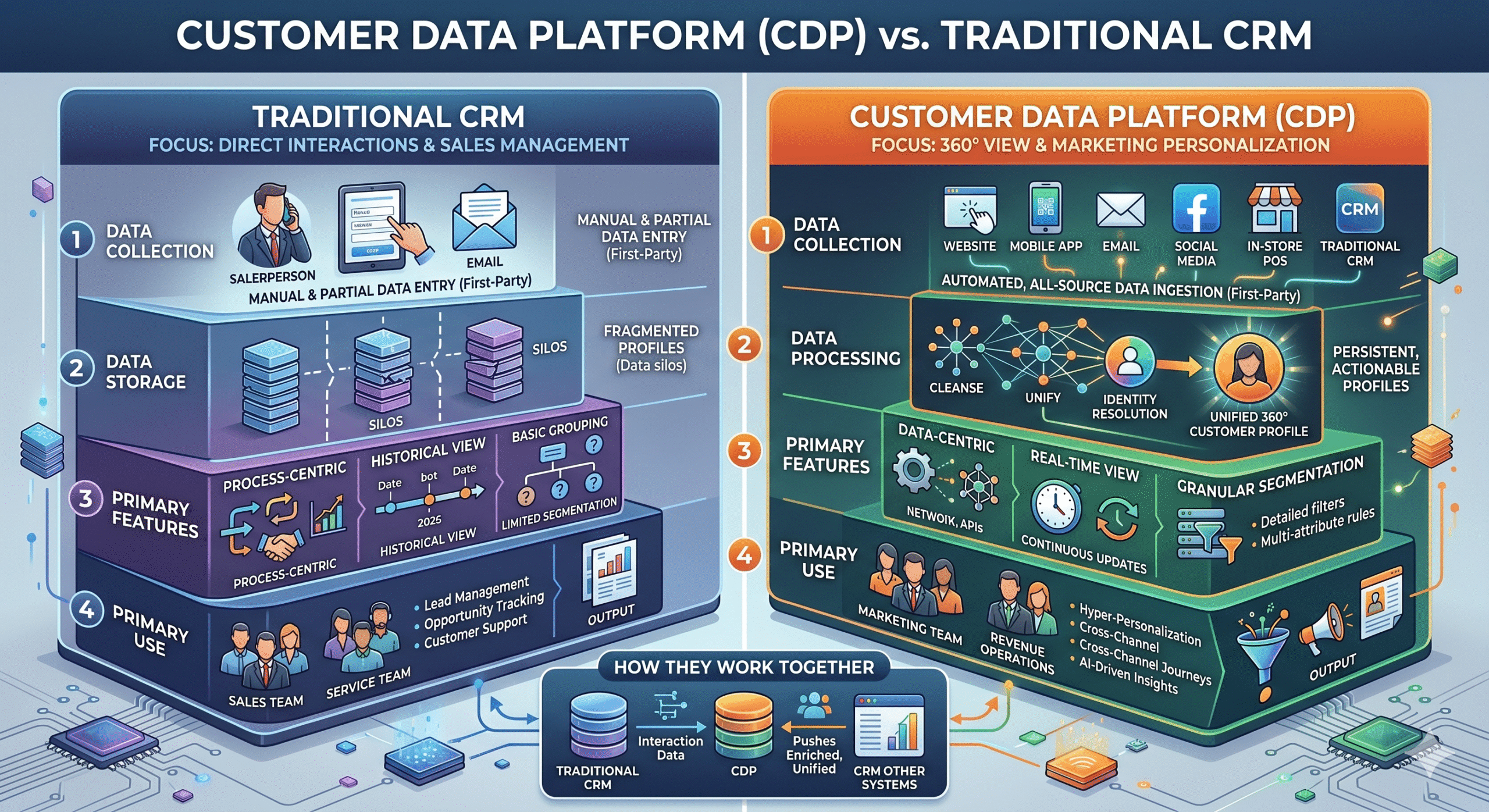
While this creates a rich pool of information, the reality is that most of this data exists in silos. Marketing teams use one system, ecommerce teams use another, and customer service relies on a different platform altogether.
This fragmentation leads to several issues:
- Inconsistent customer experiences
- Duplicate or incomplete customer profiles
- Poor targeting in campaigns
- Delayed decision-making
For example, a customer may browse products online, add items to their cart, and later visit a store to complete the purchase. Without a unified system, these interactions are treated as separate events, making it impossible to understand the full journey.
What is a Customer Data Platform?
A customer data platform is designed to solve this problem by collecting, unifying, and activating customer data from multiple sources. It creates a single, persistent profile for each customer that includes both known and anonymous interactions.
Key capabilities of a customer data platform include:
- Data ingestion from multiple online and offline sources
- Identity resolution across devices and channels
- Real-time data processing
- Audience segmentation
- Activation across marketing and engagement platforms
Unlike traditional systems, a customer data platform is built specifically for marketing and personalization use cases.
Why CDPs Are Critical for Retail Growth
Creating a Unified Customer View
At the core of a customer data platform is the ability to create a unified view of the customer. This means combining all interactions into a single profile that reflects behavior, preferences, and intent.
With this unified view, businesses can:
- Understand the full customer journey
- Identify high-value customers
- Detect patterns and trends
This level of insight is essential for making informed decisions.
Enabling Personalization at Scale
Personalization is one of the most effective ways to drive engagement and conversions. However, delivering personalized experiences across thousands or millions of users requires automation and intelligence.
A customer data platform enables:
- Dynamic audience segmentation
- Personalized product recommendations
- Tailored messaging across channels
For example, a customer browsing a specific category can immediately receive relevant recommendations or targeted emails. This improves engagement and increases the likelihood of conversion.
Supporting Omnichannel Experiences
Customers today expect a seamless experience across all touchpoints. They do not think in terms of channels. They simply interact with brands.
A customer data platform ensures that all interactions are connected, allowing businesses to deliver consistent messaging across:
- Websites
- Mobile apps
- Email campaigns
- Physical stores
This consistency is critical for building trust and improving customer experience.
Leveraging Real-Time Data
Timing plays a crucial role in customer engagement. A delayed response can result in missed opportunities.
Customer data platforms process data in real time, enabling businesses to:
- Trigger campaigns instantly
- Update personalization dynamically
- Respond to user behavior immediately
For example, a cart abandonment email sent within minutes is far more effective than one sent hours later.
Improving Marketing Efficiency
Without a unified data layer, marketing efforts often become inefficient. Campaigns are based on incomplete or outdated data, leading to poor performance.
A customer data platform improves efficiency by:
- Eliminating duplicate data
- Enhancing targeting accuracy
- Automating campaign execution
This results in better outcomes with less effort.
Real-World Impact on Retail Metrics
Implementing a customer data platform can have a measurable impact on key business metrics.
Conversion Rates
Personalized experiences increase the likelihood of purchase by aligning with customer intent.
Customer Lifetime Value
Understanding customer behavior enables businesses to deliver relevant offers and build long-term relationships.
Retention Rates
Consistent and meaningful interactions improve customer loyalty.
Marketing ROI
Better targeting and automation lead to higher returns on marketing investment.
Challenges Without a Customer Data Platform
Retailers that do not invest in a customer data platform often face:
- Fragmented customer data
- Limited personalization capabilities
- Inconsistent experiences across channels
- Slower response to customer behavior
These challenges can directly impact revenue and competitiveness.
The Role of AI in CDPs
Artificial intelligence is enhancing the capabilities of customer data platforms. AI enables:
- Predictive analytics
- Automated segmentation
- Real-time decision-making
- Continuous optimization
This allows businesses to move beyond reactive strategies and deliver proactive experiences.
The Future of Retail with CDPs
As privacy regulations evolve and third-party data becomes less accessible, first-party data is becoming increasingly important. Customer data platforms play a central role in managing and activating this data.
Future developments include:
- Deeper integration with personalization engines
- More advanced AI-driven insights
- Greater automation in customer engagement
- Enhanced cross-channel orchestration
These advancements will further strengthen the role of CDPs in retail growth.
Conclusion
Customer data platforms are no longer optional for modern retailers. They are the foundation for delivering personalized, consistent, and data-driven experiences.
By unifying customer data and enabling real-time activation, CDPs empower businesses to understand their customers better and respond more effectively.
In a competitive retail landscape, the ability to turn data into actionable insights is a key differentiator. Businesses that invest in a customer data platform will be better positioned to drive growth, improve customer relationships, and stay ahead of the competition.


